9 of the Most Iconic Music Venues in America
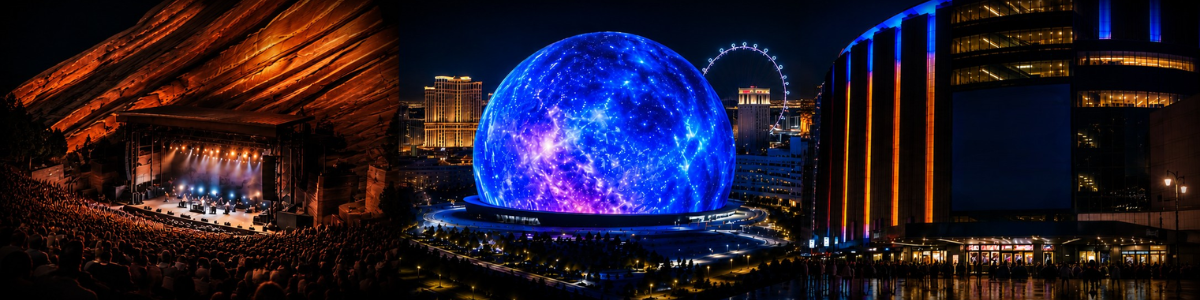
America is home to some of the greatest stages on Earth—a naturally carved sandstone amphitheater in the Colorado foothills. The world’s most famous arena is above a Manhattan train station. A 114-year-old baseball park where country legends play under the stars. A futuristic glass globe in Las Vegas that’s redefining what a concert even means.
These aren’t just venues—they’re the places where American music history was made, is being made right now, and will be made again this weekend. Some are old enough to have hosted The Beatles. Others are so new they’re changing what a live show can be. All of them carry a kind of weight you feel the moment you walk in.
Whether you’re a lifelong concertgoer building a bucket list or a first-timer trying to decide where to go, this is your guide to the nine most iconic music venues in America—and how to get tickets to every single one. See what’s playing at all of these iconic venues right now and buy tickets at boxofficeticketsales.com.
Sphere—The Future of Live Entertainment
Opened on September 29, 2023, for $2.3 billion, the Sphere is the newest venue on this list—and the most revolutionary. Standing 366 feet tall and 516 feet wide, it is just off the Las Vegas Strip near The Venetian, and it seats up to 18,600 fans inside a 160,000-square-foot space with a wraparound 16K LED screen that covers every surface above and around the audience.
Pair that with 167,000 individual speaker drivers delivering spatial audio to every seat and haptic technology embedded in the chairs, and you get a live experience no other venue on Earth can replicate. Every artist who performs here builds a custom visual universe from scratch—treating the full wraparound environment as a canvas rather than a backdrop.
U2 opened the venue in 2023, followed by the Eagles, Phish, Dead & Company, and Backstreet Boys. In 2026, Metallica’s Life Burns Faster residency and No Doubt’s reunion run rank among the most in-demand events in Las Vegas history, while the Wizard of Oz immersive experience—rebuilt to 16K resolution using AI—sold over one million tickets in its first months alone.
The 2026 lineup keeps the momentum going strong, with Eagles, Phish, No Doubt, and Illenium performing across spring and summer. Kenny Chesney arrives in June, followed by Carin León in September—making history as the first Latin artist to headline the Sphere. Metallica’s Life Burns Faster residency runs from October through March 2027, while the Wizard of Oz immersive experience plays daily throughout the year.
There’s simply nothing else like it—fans who’ve attended concerts their whole lives describe the Sphere not as a better show, but as an entirely different experience.
Red Rocks Amphitheatre —The Greatest Outdoor Venue on Earth
Carved between two 300-million-year-old sandstone monoliths at an elevation of 6,450 feet near Morrison, CO, Red Rocks Amphitheatre is the only naturally occurring, acoustically perfect outdoor amphitheater in the world. With a capacity of 9,525, it punches well above its weight—Pollstar handed it the Best Small Outdoor Venue award so many consecutive times they retired the category and renamed it after Red Rocks. In 2021, it was named the top-grossing and most-attended concert venue of any size on the planet.
Built by the Civilian Conservation Corps and opened on June 15, 1941, Red Rocks has hosted The Beatles, Jimi Hendrix, U2 (who filmed Under a Blood Red Sky here in 1983), The Grateful Dead, and hundreds of other legends across more than eight decades. Thanks to its tiered design, every seat has a completely unobstructed view—and with the Denver skyline glowing in the distance behind every performer, no other stage in America looks quite like this one.
Red Rocks was designated a National Historic Landmark in 2015 and is home to the Colorado Music Hall of Fame, open year-round. Its 2026 season marks the venue’s 85th anniversary, with highlights including Alabama Shakes, Paul Simon, Andrea Bocelli, and Reggae on the Rocks among more than 150 scheduled events.
Madison Square Garden—The World’s Most Famous Arena
Billed as “The World’s Most Famous Arena,” Madison Square Garden has sat at the center of American live music since 1968, when the fourth and current building opened above Penn Station in Midtown Manhattan, New York City. Home to the NBA’s New York Knicks and the NHL’s New York Rangers, the arena seats around 20,800, and its circular design and cable-supported ceiling deliver exceptional acoustics that have served legends across every genre imaginable.
MSG is the only venue in the world where all four individual Beatles performed solo concerts. It hosted George Harrison‘s Concert for Bangladesh in 1971—the first major benefit concert in history—along with Elvis Presley‘s sold-out run in 1972 and Led Zeppelin‘s three nights in 1973 that produced The Song Remains the Same. Billy Joel holds the record for most performances at MSG, with over 110 shows and counting.
In 2026, Harry Styles is setting a new record with a 30-show consecutive residency—more than double his landmark 15-night run in 2022 and the largest single-artist engagement in MSG history.
With 320-plus events per year, over 4 million visitors annually, and more than 150 years of history spanning every genre from classical to hip-hop, the numbers speak for themselves.
TD Garden—Boston’s Premier Arena and New England’s Home of Live Music
TD Garden is the most visited sports and entertainment venue in New England, drawing nearly 3.5 million visitors a year across more than 200 events. Opened on September 30, 1995, at 100 Legends Way in Boston’s West End—directly above North Station—it holds up to 19,580 fans for concerts and is home to both the NBA’s Boston Celtics and the NHL’s Boston Bruins. Billboard and Pollstar have ranked it among the top 10 highest-grossing venues in the world, a remarkable achievement for a market of Boston’s size.
The legacy runs deeper than the current building. The original Boston Garden (1928–1995) hosted The Beatles, Elvis Presley, Led Zeppelin, and some of the most celebrated moments in American sports history. The new arena opened in October 1995 with a concert by rock legends Boston—a fitting choice—and in 2026, it unveiled a $100 million multi-year overhaul of its suites and club experiences.
2026 concert highlights include Ariana Grande, Rosalía (LUX Tour), The Strokes, Benson Boone, and J. Cole, with plenty more on the calendar throughout the season.
Hollywood Bowl—Los Angeles’ Outdoor Crown Jewel
Nestled into a natural hillside in the Hollywood Hills, the Hollywood Bowl has been Los Angeles‘ defining outdoor venue since 1922—making it the oldest continuously operating outdoor music venue in the United States. With a capacity of 17,500, its signature white shell bandshell is one of the most recognizable structures in American music. The Los Angeles Philharmonic calls it home from June through September, but the Bowl hosts everything from classical to rock, pop, jazz, and world music throughout the summer.
Historic performances here include The Beatles in 1964 and 1965, Judy Garland, Frank Sinatra, Jimi Hendrix, and virtually every major artist of the last century.
Then there’s the Bowl’s most beloved tradition: fans are encouraged to bring their own food, wine, and beer. Full picnic spreads and bottles of wine are completely standard here, making a Hollywood Bowl evening as much a social event as a musical one. You don’t just come for the show. You dine under the stars before the music even starts.
Radio City Music Hall—The Art Deco Jewel of Midtown Manhattan
Opened on December 27, 1932, as part of Rockefeller Center in Midtown Manhattan, Radio City Music Hall might be the most beautiful concert venue in America. Designed in the Art Deco style by architect Edward Durell Stone and interior designer Donald Deskey, it features a grand gold-and-burgundy interior, a 60-foot sunburst ceiling, and an iconic stage curtain that makes it feel anything but intimate, despite a capacity of 5,960. It was designated a New York City Landmark in 1978.
For more than 90 years, Radio City has staged America’s most prestigious awards ceremonies, television specials, and milestone concerts. The annual Christmas Spectacular—starring the Radio City Rockettes—is one of the highest-grossing theatrical productions in the world, drawing over one million attendees each year. On the concert side, the venue has hosted Frank Sinatra, Judy Garland, Tony Bennett, Led Zeppelin, and nearly every significant American artist across nine decades. Its 5,960-seat capacity strikes a rare balance: large enough to feel like a major event, intimate enough that even the back rows feel close.
One more standout feature: the Great Stage. At 144 feet wide and 66 feet tall—with three hydraulic platforms that rise and fall independently—it’s one of the largest and most technically advanced indoor stages in the world.
Fenway Park—America’s Most Beloved Ballpark Turned Concert Stage
Opened on April 20, 1912—the same week the Titanic sank—Fenway Park is the oldest Major League Baseball stadium in America and one of the most recognizable sports venues in the world. Located in Boston, MA, it holds up to 37,755 fans for concerts, making it one of the largest outdoor stages in the country. Home of the Boston Red Sox, Fenway is defined by its quirks: the iconic 37-foot Green Monster in left field, the hand-operated scoreboard, and the character of a ballpark whose imperfections are very much part of its soul.
Since the first concert at Fenway in 2003—Bruce Springsteen and the E Street Band—it has earned its place as one of America’s most beloved outdoor stages. Playing here is a rite of passage: the passionate New England crowd, the ballpark atmosphere, and that iconic Green Monster backdrop create a setting unlike anywhere else. Fenway was designated a National Historic Landmark in 2012.
The 2026 concert season is one of the strongest in recent memory, with highlights including Noah Kahan across four nights in July—a homecoming for New England’s most beloved current singer-songwriter—Phish (two nights, July 31–August 1), Chris Stapleton, Tim McGraw, Zac Brown Band, and Usher and Chris Brown’s R&B Tour.
Grand Ole Opry—Country Music’s Sacred Institution
No institution is more synonymous with American country music than the Grand Ole Opry. Founded on November 28, 1925, by George D. Hay as a radio “barn dance” on WSM, it became the longest-running live radio broadcast in US history—and the defining cultural institution of an entire genre. Now housed in its current Nashville, TN home since 1974, the 4,400-seat venue has welcomed country music royalty for generations, with membership considered the genre’s highest honor. Johnny Cash, Dolly Parton, Garth Brooks, Loretta Lynn, Patsy Cline, and hundreds more built their legends on this stage.
What makes the Opry unique is that it isn’t just a concert hall—it’s a weekly show, still broadcast live on WSM radio every Friday and Saturday night, where members and guests perform in a rotating celebration of country music that has run uninterrupted for 100 years. The intimacy of the 4,400-seat house, the famous circle of wood on the stage (taken from the Ryman Auditorium), and the weight of knowing every country legend stood right there make it one of the most emotionally resonant live experiences in American music.
In 2026, the Grand Ole Opry celebrates its 100th anniversary with a centennial year of special performances, inductions, and a historic show at Carnegie Hall on March 20—only the fourth time the Opry has performed there in its entire history.
Ryman Auditorium—The Mother Church of Country Music
Opened in 1892 as the Union Gospel Tabernacle by riverboat captain Thomas Ryman, this Nashville landmark was never designed to be a concert hall—but its Gothic architecture and near-perfect acoustics made it one of the greatest stages America has ever known. From 1943 to 1974, it served as the home of the Grand Ole Opry, turning it into hallowed ground where Hank Williams, Patsy Cline, Johnny Cash, and Loretta Lynn built their legends.
Following a full restoration in the 1990s, the Ryman Auditorium reclaimed its place as one of Nashville’s most beloved live music destinations—welcoming artists across folk, Americana, rock, soul, and classical to a room where the history is practically built into the walls. Artists like Chris Stapleton, Brandi Carlile, and Jason Isbell make a point of playing here because this room makes every performance feel like something more than a show.
With just 2,362 seats, original wooden pews, and stained-glass windows framing the stage, the Ryman delivers an intimacy that bigger venues simply can’t match—making every night here feel like something special.
More Iconic American Stages Worth Knowing
No list of iconic American music venues is complete without mentioning these legendary stages.
- Carnegie Hall (New York City, NY): Opened 1891, capacity 2,804. The gold standard of musical performance in America since Tchaikovsky conducted on opening night. The Beatles, Billie Holiday, Frank Sinatra, Bob Dylan, and Aretha Franklin have all played here.
- Apollo Theater (Harlem, NY): Opened in 1934, capacity 1,506. The heartbeat of Black American music, where Ella Fitzgerald, James Brown, Lauryn Hill, and Jimi Hendrix launched their careers through Amateur Night. A National Historic Landmark since 1983.
- The Fillmore (San Francisco, CA): Opened 1912 (concerts from 1965), capacity 1,150. Birthplace of psychedelic rock, where Jimi Hendrix, Janis Joplin, The Grateful Dead, and The Doors performed under promoter Bill Graham. Still hands every concertgoer a free commemorative poster.
- Preservation Hall (New Orleans, LA): Opened in 1961, capacity around 100. The most intimate venue in America—a deliberately un-renovated hall in the French Quarter where traditional New Orleans jazz has played every night for over 65 years. No bar, no food, no amplification. Just a band and a room.
- The Gorge Amphitheater (George, WA): Opened in 1985, capacity around 20,000. One of the most breathtaking natural backdrops in live music, built on the edge of the Columbia River Gorge with 200-foot cliffs dropping to the river behind the stage.
- Allegiant Stadium (Las Vegas, NV): Opened 2020, capacity 65,000. Billboard’s Top West Coast Stadium—a $1.9 billion domed venue with a retractable lanai door, translucent roof, and 127 luxury suites. It grossed $119.2 million from just 15 concerts in 2024–25.
- The Fox Theatre (Atlanta, GA): Opened in 1929, capacity 4,665. A Moorish-style movie palace with a twinkling fiber-optic ceiling sky—one of the most ornate and beloved concert halls in the American South.
Which Stage Will You See First?
America’s most iconic music venues are more than buildings—they’re the physical places where the country’s musical soul lives. The Sphere shows us where live entertainment is going. Red Rocks, Fenway Park, and the Grand Ole Opry remind us where it came from. And Madison Square Garden, TD Garden, the Hollywood Bowl, and Radio City Music Hall stand as proof that a great room, in a great city, can become a legend all its own.
Every one of these venues has a packed calendar and a show worth traveling for. The hardest part isn’t deciding whether to go—it’s choosing where to go first.
See what’s playing at every iconic American music venue right now and get your tickets at boxofficeticketsales.com.